Learn what a full-stack developer does, essential skills, tools, and a beginner-friendly roadmap to start your coding career in 2026.
Table of Contents
1. Introduction
The modern internet runs on complex web applications that combine design, functionality, and data processing. Behind these digital experiences are developers who build and maintain the systems that power websites and online platforms. Among them, full-stack developers play a particularly important role because they can work on both the visual side of a website and the technical systems that run behind the scenes.
A full-stack developer is a versatile professional who understands the complete structure of web development. Instead of focusing on only one area, such as the user interface or the server logic, they can manage multiple layers of a web application. This includes building the front end that users interact with, developing the back end that processes data, and connecting applications with databases and external services.
Because of this broad skill set, full-stack developers are highly valued in the technology industry. Many companies prefer hiring professionals who can contribute to different parts of a project, which helps teams work faster and reduces development costs. Startups, small businesses, and even large organizations often rely on full-stack developers to build scalable and efficient web applications.
For beginners who want to enter the world of programming, understanding the role of a full-stack developer is an excellent starting point. It provides a clear picture of how websites and applications function from start to finish. In this guide, you will learn what a full-stack developer is, how full-stack development works, the technologies involved, and the skills required to succeed in this growing career field.
2. What is a full-stack developer?
A full-stack developer is a software professional who can build and manage both the front end and the back end of a web application. In simple terms, they have the skills to handle everything required to create a functional website or web app—from the visual interface users interact with to the server, database, and application logic working behind the scenes.
The term “stack” refers to the collection of technologies used to build an application. This includes programming languages, frameworks, databases, and development tools that work together to run a website. A full-stack developer understands how these layers connect and function as a complete system.
Unlike specialists who focus on only one part of development, full-stack developers have knowledge across multiple areas of the development process. They can design user interfaces, write server-side code, manage databases, and integrate different services into a single working product.
Understanding the Two Main Layers of Web Development
To fully understand the role of a full-stack developer, it helps to look at the two major parts of web development.
Front-end development deals with the visual and interactive side of a website. This includes elements such as page layouts, navigation menus, buttons, animations, and other components users see and interact with in their browsers. Front-end developers use technologies like HTML, CSS, and JavaScript to create these experiences.
Back-end development, on the other hand, focuses on the server-side operations that power the application. This includes handling user requests, processing data, communicating with databases, and ensuring that the website runs smoothly and securely. Back-end developers typically work with programming languages, frameworks, and database systems that manage application logic and data storage.
A full-stack developer combines both of these skill sets. They understand how user actions on the front end trigger processes on the back end and how data moves between different parts of the system.
A Simple Real-World Example
Imagine an online shopping website. When a customer browses products, adds items to a cart, and completes a purchase, several processes happen simultaneously.
The front end displays product images, prices, and buttons that allow users to interact with the site. When a customer clicks “Add to Cart,” the back end processes that action, updates the cart in the database, and ensures the information is saved for the user.
A full-stack developer is capable of building and managing both sides of this process. They can create the interface customers use while also developing the server logic and database structure that store and process the information.
Why Full Stack Developers Are Valuable
Companies often value full-stack developers because they can contribute to multiple parts of a project. Instead of relying on separate specialists for every stage of development, a full-stack developer can understand the entire workflow of a web application.
This broader perspective helps improve collaboration, speed up development cycles, and simplify troubleshooting when issues arise across different parts of the system.
Because of their versatility and ability to work across the full development process, full-stack developers have become highly sought-after professionals in modern software and web development.
3. Front-End Development Explained
Front-end development is the part of web development that focuses on everything users see and interact with in a website or web application. When someone visits a website, the layout, colors, buttons, menus, images, and animations they experience are all created through front-end development.
A full-stack developer must understand front-end technologies because the user interface plays a critical role in how people experience a website. Even if a web application has powerful features on the server side, users may leave quickly if the interface is slow, confusing, or poorly designed. Front-end development ensures that websites are visually appealing, responsive, and easy to use across different devices such as smartphones, tablets, and desktops.
Front-end developers work closely with designers to transform visual designs into functional web pages. They write code that controls how elements appear on the screen and how users interact with them. This includes creating navigation menus, forms, interactive buttons, and dynamic content that updates without reloading the page.
Modern front-end development also focuses heavily on performance and responsiveness. Websites must load quickly and adapt to different screen sizes. Because of this, developers use advanced tools and frameworks to build smooth and engaging user experiences.
3.1 What Is Front-End Development?
Front-end development refers to the process of building the client-side portion of a website or web application. The term “client-side” means the part of the application that runs directly in a user’s web browser.
The main goal of front-end development is to create a seamless and interactive experience for users. Developers structure web pages, design layouts, and implement features that allow users to interact with the website. This includes actions like clicking buttons, submitting forms, browsing products, or navigating between pages.
Front-end development combines both technical and creative skills. Developers must understand coding while also thinking about usability, accessibility, and design consistency. A well-developed front-end ensures that users can easily find information and complete tasks without frustration.
For full-stack developers, front-end knowledge allows them to build complete applications from start to finish. Instead of relying on separate teams for user interface development, they can design and implement the visible layer of the application themselves.
3.2 Core Front-End Technologies
Front-end development relies on three core technologies that form the foundation of nearly every website on the internet.
HTML (HyperText Markup Language)
HTML provides the basic structure of a webpage. It outlines how different components—such as headings, paragraphs, images, links, tables, and forms—are structured within a page. Think of HTML as the skeleton that organizes all the content on a web page.
CSS (Cascading Style Sheets)
CSS controls the visual appearance of a website. It allows developers to style HTML elements by changing colors, fonts, spacing, layout, and responsiveness. CSS is responsible for making websites look attractive and consistent across different devices.
JavaScript
JavaScript adds interactivity and dynamic functionality to websites. With JavaScript, developers can create features like dropdown menus, sliders, live search results, form validation, and interactive animations. It allows web pages to respond to user actions in real time.
Together, HTML, CSS, and JavaScript form the core building blocks of front-end development. Every modern website uses these technologies to deliver a functional and engaging user experience.
3.3 Popular Front-End Frameworks
As web applications have become more complex, developers have started using front-end frameworks and libraries to speed up development and improve code organization.
React
React is a well-known JavaScript library that helps developers create fast, interactive, and scalable user interfaces. It allows developers to create reusable components, which helps simplify large and complex applications.
Angular
Angular is a comprehensive front-end framework designed for building large-scale web applications. It provides built-in tools for routing, state management, and application structure.
Vue.js
Vue.js is known for its simplicity and flexibility. Many developers choose Vue because it is easy to learn while still being powerful enough to build modern web applications.
These frameworks help developers build faster, maintain cleaner code, and create smoother user experiences. For full-stack developers, learning at least one front-end framework can significantly improve their ability to develop modern web applications.
4. Back-End Development Explained
Back-end development refers to the server-side part of a web application that users do not see but rely on every time they interact with a website or app. While the front end handles what users see in the browser, the back end manages the logic, databases, authentication, and server communication that make the application function properly.
In simple terms, the back end is the engine behind a website. When a user submits a form, logs into an account, or searches for information, the request is sent to the server where the back-end system processes the data and returns the correct result.
For example, when someone logs into an online store, the back-end system verifies the username and password, retrieves account data from the database, and sends the information back to the browser. Without back-end development, websites would only display static pages and would not be able to store or process user data.
Back-end developers focus on building systems that are secure, scalable, and efficient so that web applications can handle thousands or even millions of users.
4.1 What Is Back-End Development?
Back-end development involves creating and maintaining the server-side logic that powers websites and applications. It includes working with servers, databases, and application programming interfaces (APIs) to ensure that data flows smoothly between the user interface and the database.
The main responsibilities of back-end development include:
- Processing user requests from the front end
- Managing and storing data in databases
- Implementing authentication and security systems
- Creating APIs for communication between different systems
- Handling server performance and scalability
For instance, when a user adds a product to an online shopping cart, the back-end system updates the database, calculates totals, and ensures the correct data is displayed on the front end. This process happens instantly in the background.
4.2 Common Back-End Programming Languages
Full-stack developers typically work with several back-end programming languages depending on the project requirements. Each language offers different strengths for building web applications.
Some widely used back-end languages include:
JavaScript (Node.js)
JavaScript is no longer limited to front-end development. With Node.js, developers can use JavaScript to build fast and scalable server-side applications. This allows full-stack developers to use the same language for both front-end and back-end.
Python
Python is known for its simple syntax and strong community support. It is widely used for web development, data processing, and automation. Many developers choose Python for building reliable and maintainable web applications.
Java
Java is a powerful and enterprise-level programming language commonly used for large-scale applications. Many banking systems, enterprise platforms, and complex applications rely on Java for stability and performance.
PHP
PHP has been a popular server-side language for many years and powers a large portion of the web. It is widely used for building dynamic websites and content management systems.
Ruby
Ruby is known for its clean and developer-friendly syntax. It allows developers to build web applications quickly and efficiently, making it a popular choice for startups and rapid development projects.
4.3 Back-End Frameworks
Back-end frameworks help developers build applications faster by providing pre-built structures, tools, and libraries. Instead of writing every feature from scratch, developers can use frameworks to handle common tasks like routing, database connections, and authentication.
Some commonly used back-end frameworks include:
Express.js
Express.js is a lightweight framework built for Node.js. It is widely used for building APIs and web applications quickly while maintaining flexibility.
Django
Django is a powerful Python framework known for its strong security features and structured architecture. It helps developers build robust applications with less code.
Laravel
Laravel is a modern PHP framework that simplifies many development tasks such as authentication, routing, and database management. It is widely used for building scalable web applications.
Spring Boot
Spring Boot is a popular Java framework designed for creating enterprise-level applications. It simplifies configuration and allows developers to build high-performance systems efficiently.
Back-end development is a critical component of full-stack development because it ensures that applications process data correctly, maintain security, and perform reliably. A strong understanding of back-end technologies enables full-stack developers to build complete web applications that work seamlessly from the user interface to the database.
5. Database Technologies Used by Full Stack Developers
A full-stack developer not only builds the user interface and server-side logic but also manages how data is stored, retrieved, and organized. Databases play a critical role in modern web applications because almost every application needs to store information such as user accounts, product details, orders, messages, or analytics data.
Full-stack developers work with different types of databases depending on the project requirements. The two main categories are SQL databases and NoSQL databases. Understanding how these database systems work allows developers to build applications that are reliable, scalable, and efficient.
5.1 SQL Databases
SQL databases are also known as relational databases. They store data in structured tables made up of rows and columns. Each table represents a specific type of data, and relationships between tables allow developers to organize information efficiently.
These databases use Structured Query Language (SQL) to insert, update, retrieve, and manage data.
One major advantage of SQL databases is their strong data consistency and reliability. Because of this, they are commonly used in systems where accurate data management is critical, such as e-commerce platforms, financial applications, and enterprise software.
Several SQL database platforms are widely adopted across the industry, including:
MySQL
MySQL is one of the most popular open-source relational databases used in web development. It is widely known for its speed, reliability, and strong community support. Many websites and content management systems rely on MySQL to manage large amounts of structured data.
PostgreSQL
PostgreSQL is another powerful relational database known for its advanced features and strong performance. It supports complex queries, custom data types, and high levels of data integrity. Developers often choose PostgreSQL for applications that require complex data processing.
SQL databases are a common choice when applications require well-structured data and clear relationships between different data entities.
5.2 NoSQL Databases
NoSQL databases are designed to handle data that does not always fit neatly into tables. Instead of using rigid structures, these databases allow more flexible ways of storing information, such as documents, key-value pairs, or graphs.
Because of this flexibility, NoSQL databases are often used for modern applications that need to scale quickly or manage large volumes of unstructured data.
Two widely used NoSQL databases are:
MongoDB
MongoDB stores data in a format similar to JSON documents. This structure makes it easier for developers to work with dynamic data and rapidly changing application requirements. MongoDB is commonly used in modern web applications, especially those built with JavaScript frameworks.
Firebase
Firebase provides a cloud-based NoSQL database designed for real-time applications. It allows data to synchronize instantly across multiple devices, making it a popular choice for mobile apps, chat applications, and collaborative platforms.
NoSQL databases are particularly useful for applications that require high scalability, flexible data structures, and fast performance.
5.3 How Databases Connect to Applications
In a full-stack application, the database communicates with the back-end server rather than the user interface directly. The back-end acts as the bridge that handles requests from the front end and interacts with the database to retrieve or update data.
For example, when a user logs into a website, the following process typically happens:
- The user enters their login details on the front end.
- The request is sent to the server.
- The server checks the database to verify the user’s information.
- The database returns the result to the server.
- The server sends the response back to the front end.
Full-stack developers use technologies such as APIs, database drivers, and server frameworks to connect applications with databases securely and efficiently.
In modern web development, choosing the right database technology is essential. A skilled full-stack developer understands when to use relational databases for structured data and when to use NoSQL systems for flexible, large-scale applications. This knowledge ensures that web applications remain fast, secure, and capable of handling growing amounts of data.
6. Key Skills Required to Become a Full Stack Developer
A full-stack developer needs a wide range of technical and practical skills because the role covers both the client side and server side of a web application. Instead of specializing in only one area, full-stack developers understand how different parts of a website work together. Below are the essential skills required to become a successful full-stack developer.
6.1 Front-End Development Skills
Front-end development is responsible for creating the visual and interactive components of a website that visitors use in their browsers. A full-stack developer should understand how to design and build responsive, user-friendly interfaces.
Important front-end skills include:
- HTML – Used to create the structure of web pages.
- CSS – Controls layout, colors, fonts, and overall design.
- JavaScript – A programming language used to create interactive and dynamic experiences on websites.
In addition to core technologies, modern developers often work with front-end libraries and frameworks to build faster and more scalable interfaces.
Key front-end concepts include:
- Responsive design for mobile and desktop devices
- UI and UX best practices
- Browser compatibility
- Front-end performance optimization
Strong front-end knowledge ensures that users have a smooth and engaging experience when interacting with a website or application.
6.2 Back-End Programming Knowledge
Back-end development manages the logic, servers, and processes that run behind the scenes of a web application. Full-stack developers need to understand how data flows between the user interface and the server.
Common back-end languages include:
- JavaScript (Node.js)
- Python
- PHP
- Java
- Ruby
Back-end development typically involves:
- Creating application logic
- Handling user authentication
- Processing requests from the front-end
- Managing server communication
Having strong back-end skills allows developers to build secure and efficient web applications.
6.3 Database Management
Most websites rely on databases to store and organize information such as user data, product details, or content. A full-stack developer should understand how databases work and how to connect them with applications.
There are two main types of databases developers work with:
SQL databases
- MySQL
- PostgreSQL
- Microsoft SQL Server
NoSQL databases
- MongoDB
- Firebase
- Cassandra
Developers should know how to:
- Design database structures
- Perform queries
- Store and retrieve data efficiently
- Optimize database performance
Proper database management helps ensure that applications run smoothly even when handling large amounts of data.
6.4 Version Control Systems
Version control systems help developers track code changes, collaborate with teams, and manage project history. This is an essential skill for modern software development.
One of the most widely used tools is Git.
Key benefits of version control include:
- Tracking modifications in the codebase
- Collaborating with other developers
- Rolling back changes when errors occur
- Managing multiple development branches
Platforms such as Git repositories also make it easier for developers to showcase their work and contribute to open-source projects.
6.5 API Integration and Development
Application Programming Interfaces (APIs) allow different software systems to communicate with each other. Full-stack developers often integrate external services into web applications using APIs.
Examples of API usage include:
- Payment gateway integration
- Social media login systems
- Weather or location services
- Data exchange between applications
Understanding how to create and consume APIs helps developers build more powerful and flexible applications.
6.6 Problem-Solving and Debugging Skills
Technical knowledge alone is not enough to succeed as a full-stack developer. Strong problem-solving skills are equally important.
Developers regularly face issues such as:
- Code errors
- Server failures
- Performance problems
- Unexpected user behavior
Debugging involves identifying the cause of an issue and implementing an effective solution. Developers who can quickly analyze problems and fix them efficiently are highly valued in the software industry.
6.7 Understanding Web Security Basics
Security is a critical aspect of web development. Full-stack developers must understand how to protect applications and user data from common vulnerabilities.
Important security practices include:
- Input validation
- Secure authentication systems
- Protecting databases from unauthorized access
- Preventing common attacks such as cross-site scripting and SQL injection
Knowledge of web security ensures that applications remain reliable and trustworthy for users.
In summary, becoming a full-stack developer requires a combination of front-end expertise, back-end programming knowledge, database skills, and practical development tools. Developers who master these skills can build complete web applications from start to finish and adapt to a wide variety of technology projects.
7. Tools Commonly Used by Full Stack Developers
Full-stack developers rely on a wide range of tools to build, test, manage, and deploy web applications efficiently. Since they work on both the front-end and back-end of a project, the tools they use help streamline development, improve productivity, and maintain clean code. Below are some of the most commonly used tools that help full-stack developers manage the entire development process.
Code Editors and Development Environments
A code editor is one of the most important tools for any developer. It is where developers write, edit, and organize their code. Modern editors come with features like syntax highlighting, extensions, debugging support, and intelligent code suggestions that make development faster and more efficient.
Popular code editors used by full-stack developers include Visual Studio Code, Sublime Text, and Atom. These tools allow developers to work with multiple programming languages and frameworks within a single environment. Extensions and plugins further enhance productivity by adding support for frameworks, debugging tools, and version control.
Version Control Systems
Version control systems help developers track changes in their code over time. This is essential when working on large projects or collaborating with other developers. Version control allows developers to revert to previous versions of code, manage updates, and avoid conflicts during teamwork.
Git is the most widely used version control system in modern software development. It enables developers to create branches, merge code, and maintain a complete history of project changes. Platforms like GitHub and GitLab provide cloud-based repositories where teams can collaborate and manage their projects efficiently.
Package Managers
Package managers simplify the process of installing and managing external libraries or dependencies required by a project. Instead of manually downloading files, developers can install packages using simple commands.
For JavaScript development, npm (Node Package Manager) and Yarn are commonly used. These tools allow developers to install frameworks, libraries, and tools that enhance application functionality. Package managers also ensure that projects maintain consistent dependency versions across different development environments.
API Development and Testing Tools
Full-stack developers often integrate APIs to connect different parts of an application or to communicate with external services. API testing tools help developers send requests, analyze responses, and verify that the backend services are working correctly.
Tools like Postman and Insomnia are widely used for testing RESTful APIs. They provide a simple interface for sending HTTP requests, inspecting responses, and automating API testing workflows.
Database Management Tools
Since full-stack developers work with databases, they also need tools to manage and interact with data efficiently. Database management tools help developers create tables, run queries, and analyze stored information.
Tools such as phpMyAdmin, MongoDB Compass, and Adminer make it easier to manage databases visually. These tools allow developers to view data structures, edit records, and troubleshoot database-related issues without writing complex queries every time.
Testing and Debugging Tools
Testing is a critical part of the development process. Developers must ensure that applications function correctly and provide a smooth user experience. Testing tools help identify bugs, errors, and performance issues before the application goes live.
Popular testing frameworks include Jest, Mocha, and Cypress for JavaScript-based applications. Debugging tools built into browsers, such as Chrome Developer Tools, also allow developers to inspect elements, monitor network activity, and analyze performance.
Deployment and Hosting Platforms
After building an application, the next step is deployment. Deployment tools help developers publish their applications online so users can access them. These platforms also manage servers, handle traffic, and maintain application performance.
Common deployment platforms include Netlify, Vercel, Heroku, and AWS. These services allow developers to deploy applications quickly, manage updates, and scale resources as the project grows.
Why These Tools Matter
The right set of tools can significantly improve a developer’s workflow. They reduce repetitive tasks, automate processes, and make collaboration easier. For full-stack developers, using efficient tools is essential because they handle multiple aspects of web development, from user interface design to server management.
As technology continues to evolve, new development tools are constantly being introduced. Successful full-stack developers stay updated with modern tools and adapt their workflow to maintain efficiency and productivity.
8. Full Stack Developer Responsibilities
A full-stack developer is responsible for building and maintaining both the front-end and back-end parts of a web application. Unlike specialized developers who focus on only one layer of development, full-stack developers work across the entire technology stack. Their responsibilities involve designing user interfaces, writing server-side logic, managing databases, and ensuring the application runs smoothly from start to finish.
Because of their broad skill set, full-stack developers often act as a bridge between different parts of a development team. They understand how each component of an application connects and can solve problems across multiple layers of the system.
Below are some of the core responsibilities of a full-stack developer.
Designing and Developing User Interfaces
One of the key responsibilities of a full-stack developer is creating the front-end interface that users interact with. This includes designing layouts, implementing navigation elements, and ensuring that pages are visually appealing and responsive across different devices.
Full-stack developers use technologies like HTML, CSS, and JavaScript to build interactive and user-friendly interfaces. They also work with modern frameworks to improve performance and maintainability. A well-designed front-end helps users easily access features and improves the overall user experience.
Building Server-Side Logic
In addition to front-end development, full-stack developers are responsible for creating the server-side functionality that powers an application. This includes writing code that processes user requests, manages authentication, and handles application logic.
Server-side development ensures that data flows correctly between the user interface and the database. Developers use programming languages and frameworks designed for back-end systems to ensure the application remains secure, scalable, and efficient.
Managing Databases and Data Storage
Every web application relies on data, whether it is user information, product details, or transaction records. Full-stack developers design and manage the databases that store and organize this data.
Their responsibilities include creating database structures, writing queries to retrieve information, and ensuring data is stored securely. They also optimize database performance so applications can handle large amounts of data without slowing down.
Integrating APIs and Third-Party Services
Modern web applications often rely on external services such as payment gateways, authentication tools, and cloud storage platforms. Full-stack developers integrate these services using APIs (Application Programming Interfaces).
This integration allows different systems to communicate with each other. For example, a full-stack developer may connect an application to a payment processor, social media login system, or email service. Proper API integration improves functionality while reducing development time.
Testing and Debugging Applications
Testing is an important part of the development process. Full-stack developers regularly test applications to ensure every feature works as expected. They identify bugs, troubleshoot technical issues, and fix errors that may affect performance.
By testing both the front-end and back-end components, they ensure that users have a smooth experience when interacting with the application. Continuous debugging and monitoring also help prevent security vulnerabilities.
Maintaining and Updating Web Applications
After a web application is launched, development does not stop. Full-stack developers are responsible for maintaining the system, updating features, and improving performance over time.
This may include fixing issues reported by users, upgrading frameworks, improving loading speed, or adding new functionality. Regular maintenance ensures the application stays secure, modern, and compatible with evolving technologies.
Collaborating With Teams and Stakeholders
Although full-stack developers have a wide range of technical skills, they often work closely with designers, product managers, and other developers. They help translate project requirements into functional features and ensure that both the visual and technical parts of a project align with business goals.
Effective communication and collaboration are essential, especially in larger development teams where different specialists contribute to the same project.
In summary, a full-stack developer plays a versatile role in modern web development. From designing interfaces to managing servers and databases, they handle multiple aspects of application development. This ability to work across the entire technology stack makes full-stack developers highly valuable for startups, businesses, and development teams looking for flexible and efficient technical expertise.
9. Benefits of Hiring a Full Stack Developer
Hiring a full-stack developer offers multiple advantages for businesses of all sizes. These professionals are versatile, skilled in both front-end and back-end development, and can streamline the entire software development process. Below are the key benefits:
1. Cost Efficiency
Full-stack developers can handle multiple aspects of a project, from designing user interfaces to managing databases and server logic. By hiring one professional instead of separate front-end and back-end developers, businesses can significantly reduce development costs while maintaining quality.
2. Faster Project Delivery
Since full-stack developers understand the entire development stack, they can work more efficiently and troubleshoot issues across both front-end and back-end systems. This leads to faster project completion, shorter development cycles, and quicker time-to-market for your products or services.
3. Improved Communication and Collaboration
When a single developer oversees the project’s full stack, there’s less room for miscommunication between front-end and back-end teams. This unified approach ensures smoother collaboration, fewer delays, and consistent implementation of features across the application.
4. Flexibility Across Technologies
Full-stack developers are skilled in multiple programming languages, frameworks, and databases. This flexibility allows them to adapt to different project requirements, integrate new tools quickly, and scale the application as needed without relying heavily on multiple specialists.
5. End-to-End Problem Solving
From server issues to user interface bugs, full-stack developers can identify and solve problems throughout the development process. Their comprehensive knowledge ensures that issues are addressed efficiently without waiting for separate teams to handle specific tasks.
6. Easier Maintenance and Updates
Maintaining and updating an application is simpler with a full-stack developer, as they have complete knowledge of the codebase. This reduces the risk of compatibility issues and ensures that updates are implemented smoothly, keeping your application running efficiently over time.
7. Better Understanding of the User Experience
Full-stack developers work on both the client-side and server-side of applications, giving them a complete perspective on how users interact with the software. This holistic understanding helps create a seamless user experience, improving satisfaction and engagement.
8. Scalability and Future-Proofing
Hiring a full-stack developer ensures that your application is designed with scalability in mind. They can plan for future growth, implement modular code, and integrate new technologies as your business evolves, saving time and money in the long run.
9. Versatility for Startups and Small Businesses
For startups or small businesses with limited budgets, full-stack developers are invaluable. Their ability to handle multiple roles allows a lean team to build, launch, and maintain a complete application without needing a large development department.
Hiring a full-stack developer is a strategic investment that combines cost-efficiency, speed, flexibility, and technical expertise. Businesses benefit from reduced development costs, smoother project execution, and scalable solutions that can grow with their needs.
10. Full Stack Developer vs Front-End Developer
Key Differences in Roles
A full-stack developer handles both the front-end (what users see) and the back-end (server, database, and application logic) of a website or application. They are responsible for the entire development process, from designing the user interface to managing server-side operations.
In contrast, a front-end developer focuses solely on the client side. Their primary responsibility is to create visually appealing, responsive, and interactive interfaces that users engage with. They work closely with designers to turn mockups into functional websites or applications, but typically do not manage databases or server-side logic.
Simply put, full-stack developers are generalists with broad technical expertise, while front-end developers are specialists in user-facing interfaces.
Skillset Comparison
| Skill Area | Full Stack Developer | Front-End Developer |
|---|---|---|
| Front-End Development | Advanced (HTML, CSS, JavaScript, frameworks like React or Angular) | Expert (HTML, CSS, JavaScript, UI frameworks) |
| Back-End Development | Required (Node.js, Python, PHP, databases) | Not required |
| Database Management | Required (SQL & NoSQL) | Not required |
| API Integration | Required (REST, GraphQL) | Occasionally, for connecting front-end features |
| Design & UX Skills | Basic to moderate | Strong focus on UI/UX design |
| Problem-Solving | Broad problem-solving across full stack | Focused on front-end issues |
This comparison highlights that full-stack developers have a wider range of technical responsibilities, while front-end developers focus deeply on creating seamless and interactive user experiences.
When Businesses Hire for Each Role
- Full Stack Developers: Ideal for startups or small teams that need versatile developers who can handle both front-end and back-end work. They are also preferred when a project requires end-to-end development, quick prototyping, or cost efficiency.
- Front-End Developers: Typically hired by larger teams or companies where specialization in design, user experience, and interface performance is critical. They are essential when the project demands pixel-perfect UI, animations, or complex user interactions.
In short, full-stack developers provide flexibility and broad coverage, whereas front-end developers offer specialized expertise for visually rich and interactive applications.
11. Full Stack Developer vs Back-End Developer
When exploring careers in web development, it’s common to wonder about the differences between a full-stack developer and a back-end developer. While both roles are essential in building web applications, their focus, responsibilities, and career trajectories vary significantly.
Scope of Work Differences
A back-end developer primarily focuses on the server-side of applications. They handle databases, server logic, APIs, and ensure the application’s functionality behind the scenes. Their work is critical for data storage, security, and performance optimization.
On the other hand, a full-stack developer manages both the back-end and front-end. This means they work not only on databases and server logic but also on designing user interfaces, implementing interactive features, and ensuring a seamless user experience. Essentially, full-stack developers bridge the gap between client-side and server-side development.
Technical Responsibilities
Back-End Developers:
- Build and maintain server-side applications
- Manage databases and optimize queries
- Design and implement APIs for data exchange
- Ensure application security and scalability
- Integrate third-party services
Full Stack Developers:
- Perform all back-end tasks listed above
- Design and develop responsive front-end layouts using HTML, CSS, and popular JavaScript frameworks
- Handle front-end and back-end integration
- Debug issues across the entire technology stack
- Ensure smooth performance from server to browser
Career Path Comparison
Back-End Developer Career Path:
- Usually starts with mastering a specific back-end language (e.g., Python, Java, Node.js)
- May specialize in databases, API development, or cloud architecture
- Often advances to roles like Senior Back-End Developer, System Architect, or DevOps Engineer
Full Stack Developer Career Path:
- Starts with learning both front-end and back-end technologies
- Gains experience in multiple stacks like MERN, MEAN, or LAMP
- Can progress to Senior Full Stack Developer, Technical Lead, or CTO, leveraging their broad skill set to oversee entire projects
In short, while back-end developers are specialists in server-side programming, full-stack developers are versatile professionals capable of handling both client and server-side tasks. Choosing between the two depends on whether you prefer to specialize deeply or work across the entire application ecosystem.
12. How to Become a Full Stack Developer
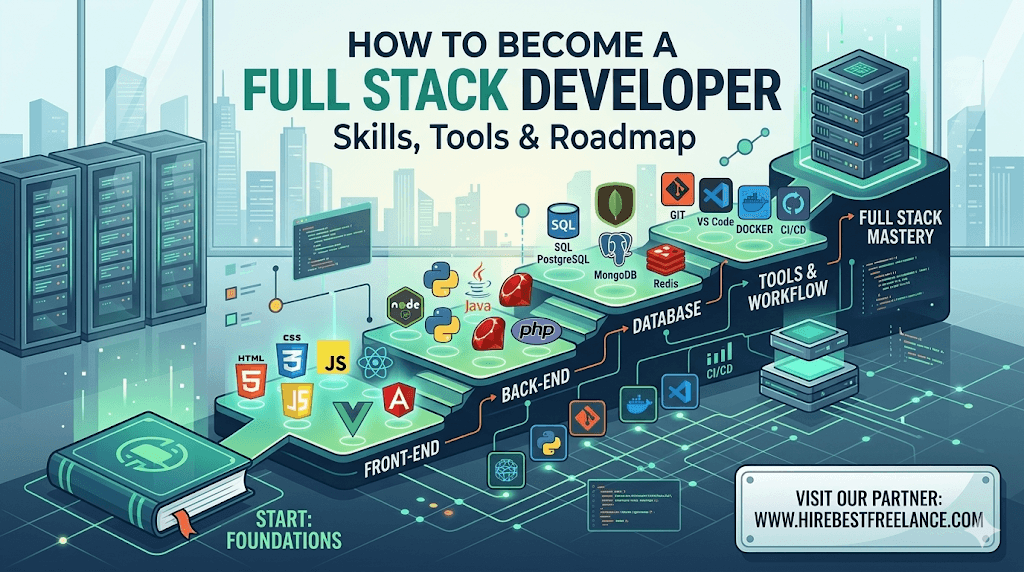
Becoming a full-stack developer requires a combination of technical knowledge, hands-on practice, and continuous learning. Unlike specializing in only front-end or back-end, full-stack developers need to master multiple layers of web development. Here’s a step-by-step roadmap to start your journey:
12.1 Learn Core Web Technologies
The first step is to understand the building blocks of web development:
- HTML (Hypertext Markup Language): This forms the structure of websites, from headings to buttons.
- CSS (Cascading Style Sheets): CSS adds styling and layout, making web pages visually appealing.
- JavaScript: A versatile language that brings interactivity and dynamic features to web pages.
Once you are comfortable with these basics, you should explore front-end frameworks like React, Angular, or Vue.js to build professional-level interfaces.
12.2 Choose a Development Stack
A full-stack developer works with both front-end and back-end technologies, often grouped into “stacks.” Choosing a stack helps focus your learning path:
- MERN Stack: MongoDB, Express.js, React, Node.js
- MEAN Stack: MongoDB, Express.js, Angular, Node.js
- LAMP Stack: Linux, Apache, MySQL, PHP
Selecting a stack allows you to learn related technologies in a structured way and makes it easier to build complete applications.
12.3 Build Real Projects
Theory alone won’t make you a full-stack developer. Start building real-world projects to apply your skills:
- Personal portfolio website
- To-do list or task manager
- E-commerce store
- A blog platform with user authentication
Building projects not only strengthens your knowledge but also demonstrates your abilities to potential employers or clients.
12.4 Learn Version Control and Deployment
Every professional developer needs to know how to manage code and deploy applications:
- Version control: Learn Git and GitHub to track changes, collaborate with others, and manage code efficiently.
- Deployment: Practice hosting your applications using platforms like Heroku, Netlify, or AWS.
- Continuous Integration/Deployment (CI/CD): Understanding these practices ensures your applications run smoothly in production.
12.5 Build a Portfolio
A strong portfolio is essential to showcase your skills:
- Include live projects with working demos
- Highlight the technologies used and your role in each project
- Use GitHub repositories to show clean, well-documented code
- Add a personal website that reflects your front-end and back-end abilities
A professional portfolio is often the first thing employers or clients check, making it a critical step in your full-stack career.
💡 Pro Tip: Consistency is key. Dedicate time every week to practice coding, build projects, and learn new technologies. Over time, your skills and confidence will grow, making you a successful full-stack developer.
13. Popular Full Stack Development Stacks
A full-stack development stack is a set of technologies a developer uses to build both the front-end and back-end of an application. Choosing the right stack can speed up development, ensure better compatibility, and help maintain scalable projects. Let’s explore some of the most popular full-stack development stacks in 2026.
13.1 MERN Stack
MERN is a full-stack development framework that combines MongoDB, Express.js, React, and Node.js to build modern web applications. It is one of the most widely used full-stack combinations for modern web applications.
- MongoDB: A NoSQL database designed to store data in flexible documents similar to JSON format.
- Express.js: A back-end web application framework for Node.js that simplifies server-side coding.
- React: A front-end library for building dynamic, interactive user interfaces.
- Node.js: A JavaScript runtime that allows developers to write server-side code in JavaScript.
Why MERN is popular:
- Uses a single language (JavaScript) across the stack
- Great for building scalable and high-performance web apps
- Large community support and plenty of learning resources
13.2 MEAN Stack
MEAN stack refers to a combination of four technologies: MongoDB, Express.js, Angular, and Node.js. It is similar to MERN but uses Angular instead of React for the front end.
- Angular: A front-end framework maintained by Google for building dynamic single-page applications (SPAs).
- Node.js & Express.js: Handles server-side operations and APIs.
- MongoDB: Stores application data efficiently.
Why MEAN is popular:
- Full JavaScript stack for both client-side and server-side
- Ideal for large-scale enterprise applications
- Provides robust MVC architecture through Angular
13.3 LAMP Stack
The LAMP stack is a classic and time-tested full-stack combination: Linux, Apache, MySQL, and PHP/Python/Perl. It has been widely used for decades in web development.
- Linux: An operating system that provides stability and security
- Apache: A web server to host websites
- MySQL: Relational database for structured data
- PHP/Python/Perl: Back-end programming language
Why LAMP is popular:
- Open-source and cost-effective
- Extremely stable for hosting traditional web applications
- Wide compatibility and a strong developer community
13.4 JAMstack
JAMstack stands for JavaScript, APIs, and Markup. Unlike traditional stacks, JAMstack focuses on pre-rendering static pages and using APIs for dynamic functionality.
- JavaScript: Handles dynamic elements and front-end interactivity
- APIs: Connects to external services or back-end functionality
- Markup: Pre-built HTML files for fast loading and SEO benefits
Why JAMstack is popular:
- Extremely fast performance due to static site generation
- Enhanced security by reducing server-side vulnerabilities
- Ideal for modern web apps, blogs, e-commerce, and progressive web apps (PWAs)
Choosing the right full stack depends on your project goals. While MERN and MEAN are excellent for dynamic, JavaScript-heavy applications, LAMP remains reliable for traditional web apps, and JAMstack excels in performance-driven, API-centric websites. Understanding these stacks helps developers pick the best tools to build scalable, maintainable, and high-performing web applications.
14. Full Stack Developer Salary and Career Opportunities
Average Salary Ranges Globally
Full-stack development is one of the most lucrative careers in tech today. Salaries vary based on location, experience, skill level, and the technologies a developer specializes in.
- United States: Entry-level full-stack developers typically earn around $65,000–$85,000 per year, while experienced developers can make $110,000–$150,000 or more annually.
- Europe: Salaries vary by country. For example, developers in Germany earn €50,000–€75,000, while those in the UK can earn £45,000–£70,000 per year.
- Asia: In India, early-career full-stack developers earn around ₹400,000–₹700,000 per year, and senior developers can make ₹1,500,000 or more annually.
- Other regions: Australia, Canada, and the Middle East offer competitive salaries, typically ranging from $70,000–$120,000, depending on experience and project expertise.
These numbers show that full-stack development is globally recognized as a high-paying career, making it an attractive choice for ambitious developers.
Demand in the Tech Industry
Companies value professionals who can handle both front-end and back-end development, making projects faster and more cost-efficient.
- Startups: Often prefer full-stack developers to reduce team size while covering all aspects of a project.
- Enterprises: Use full-stack developers to manage multiple web applications, integrate APIs, and maintain existing systems.
- Remote work opportunities: Many tech companies hire full-stack developers globally, increasing demand beyond traditional office locations.
According to industry reports, the full-stack developer role is expected to grow by over 15% in the next five years, reflecting strong job security and career stability.
Freelance vs Full-Time Opportunities
Full-stack developers can choose between full-time employment and freelance work, each with its own benefits.
Full-time employment:
- Provides stable income, benefits, and opportunities for career growth.
- Allows developers to work on long-term projects, collaborate with teams, and specialize in particular stacks.
Freelance work:
- Offers flexibility and the potential to earn more per project.
- Freelancers can take multiple projects across industries like e-commerce, SaaS, and app development.
- Platforms like Upwork, Fiverr, and Toptal provide freelancers with a steady stream of global clients.
In short, freelancing allows for independence and higher earning potential, while full-time roles provide stability, mentorship, and career progression. Many developers combine both paths to maximize experience and income.
💡 Pro Tip: To maximize earnings, focus on in-demand stacks like MERN (MongoDB, Express, React, Node.js) or MEAN (MongoDB, Express, Angular, Node.js) and gain experience with cloud deployment and API integration, as these skills significantly increase your market value.
15. Challenges Full Stack Developers Face
Full-stack development is a rewarding career, but it comes with its own set of challenges. A full-stack developer needs to juggle multiple responsibilities, making the role both demanding and dynamic. Here are some of the most common challenges they face:
1. Managing Multiple Technologies
Full-stack developers work with both front-end and back-end technologies, often switching between languages, frameworks, and tools within a single project. This requires deep knowledge across multiple domains, from UI/UX design principles to server-side logic. Keeping all these technologies in sync can be challenging, especially when projects become complex or deadlines are tight. Efficient multitasking and strong organizational skills are essential to ensure that all layers of a web application work seamlessly together.
2. Keeping Up with Rapidly Changing Frameworks
The world of web development evolves quickly. New frameworks, libraries, and tools emerge constantly, while existing ones are regularly updated. For instance, front-end frameworks like React, Angular, or Vue.js release updates that can introduce new patterns or deprecate older methods. Similarly, back-end technologies such as Node.js, Django, or Laravel evolve with new features and best practices. Full-stack developers must continuously learn and adapt to stay relevant and maintain their efficiency, which can be mentally demanding and time-consuming.
3. Balancing Front-End and Back-End Expertise
Being proficient in both front-end and back-end development is a core requirement for full-stack developers. However, balancing these two domains can be tricky. Focusing too much on one side may lead to weaker skills in the other, which can affect the overall quality of the application. Full-stack developers must strategically divide their time and effort to maintain a strong understanding of both user interface design and server-side functionality. This balancing act requires dedication, practice, and a well-planned learning approach.
💡 Tip for Aspiring Developers: To overcome these challenges, it’s essential to prioritize continuous learning, build real-world projects, and use modern tools that streamline full-stack development. This approach ensures developers remain confident and competent across both front-end and back-end technologies.
16. Future of Full Stack Development
The world of full-stack development is evolving rapidly, and the future promises exciting opportunities for developers who are versatile and adaptive. As businesses increasingly rely on digital solutions, the demand for developers who can handle both front-end and back-end tasks is only expected to grow. Full-stack developers offer a unique advantage because they can manage entire projects, bridging gaps between design, functionality, and database management.
Growing Demand for Versatile Developers
Organizations today prefer developers who can wear multiple hats. Instead of hiring separate front-end and back-end specialists for every project, businesses find it cost-effective and efficient to employ full-stack developers. This trend is particularly strong in startups and small-to-medium enterprises, where agile teams need developers who can handle a variety of tasks. As more companies adopt digital-first strategies, the need for multi-skilled developers will continue to rise.
Impact of AI and Automation on Development
Artificial Intelligence (AI) and automation are changing how full-stack development works. Tools powered by AI can now generate code snippets, automate testing, and even suggest solutions to complex problems. While some may worry about automation replacing developers, the reality is that AI is a powerful assistant. Full-stack developers who understand how to integrate AI-driven tools into their workflow will become more productive, focusing on creative and strategic tasks while leaving repetitive coding tasks to automation.
Trends Shaping Modern Web Development
Several emerging trends are reshaping the future of full-stack development:
- Serverless Architecture: Developers can now build applications without managing servers, reducing complexity and speeding up deployment.
- Progressive Web Apps (PWAs): Full-stack developers are increasingly creating web apps that function like native mobile apps, offering better performance and user experience.
- API-First Development: With the rise of microservices, developers are designing applications around APIs, making systems more modular and scalable.
- Cloud Integration: Knowledge of cloud platforms like AWS, Azure, and Google Cloud is becoming essential as more applications migrate to the cloud.
Full-stack developers who embrace these trends and continuously update their skill set will remain highly valuable in the tech industry. The future favors those who can combine technical expertise with adaptability, creativity, and an understanding of emerging technologies.
Conclusion
A full-stack developer is a versatile professional who can handle both the front-end and back-end aspects of web development. They design user interfaces, manage servers, work with databases, and integrate APIs, making them capable of building complete web applications from start to finish. This ability to manage the entire technology stack sets them apart in the tech world.
Full-stack development is a highly valuable and future-proof skill. As businesses increasingly rely on digital solutions, the demand for developers who can work across multiple technologies continues to grow. Full-stack developers bring flexibility, efficiency, and innovation to any project, making them essential in modern web and software development.
For beginners, diving into full-stack development is both a challenging and rewarding journey. By learning core web technologies, practicing with real projects, and building a strong portfolio, anyone can start their path toward becoming a full-stack developer. With dedication and consistent learning, you can open doors to high-demand career opportunities, freelance projects, and a sustainable future in tech.
FAQs
1. Is full-stack development difficult to learn?
Full-stack development can seem challenging at first because it requires knowledge of both front-end and back-end technologies. However, with a structured learning plan, consistent practice, and real-world projects, beginners can gradually build expertise. Focusing on one technology at a time and integrating them step by step makes the learning process manageable and even enjoyable.
2. How long does it take to become a full-stack developer?
The time to become a full-stack developer depends on your learning approach and commitment. For dedicated learners, it can take 6 to 12 months of consistent study and hands-on practice to gain proficiency in the core technologies. For those learning part-time, it may take 12 to 18 months. Building real projects and a portfolio significantly accelerates career readiness.
3. Do full-stack developers need a degree?
No, a formal degree is not strictly necessary to become a full-stack developer. Numerous professional developers acquire their skills through self-study or intensive coding bootcamp programs. What matters most is practical skills, portfolio projects, and experience. However, a degree in computer science or related fields can provide a solid foundation and may help with some corporate job applications.
4. Which programming language is best for full-stack development?
The “best” language depends on your chosen stack and career goals:
JavaScript – Ideal for both front-end (React, Angular, Vue.js) and back-end (Node.js).
Python – Popular for back-end development with frameworks like Django or Flask.
Java – Used in enterprise-level applications and large systems.
PHP – Common in web development, especially with Laravel or WordPress.
Starting with JavaScript is highly recommended because it allows you to work across the entire web stack efficiently.
5. Can beginners become full-stack developers?
Yes! Beginners can become full-stack developers with dedication, the right learning path, and consistent practice. Start by mastering front-end basics (HTML, CSS, JavaScript), then gradually move to back-end technologies and databases. Building real projects and contributing to open-source code helps beginners gain practical experience and confidence in their skills.