
Hiring a good frontend developer can turn a rough idea into a website that looks professional, works smoothly, and feels easy to use. But finding the right person can be difficult when you have a fixed budget.
If your budget is under $500, you can still find capable frontend developers on Fiverr. The key is knowing what to look for — and just as important, what not to expect at this price.
A frontend developer works on the part of a website or web app that visitors see and use: layout, buttons, navigation, forms, animations, responsive design, and interactive features. Core frontend technologies include HTML, CSS, and JavaScript, while frameworks like React help build more complex interfaces. MDN’s current frontend curriculum highlights responsive design, accessibility, JavaScript, CSS, HTML, frameworks, and version control as key areas.
The good news: you don’t need to spend $1,000+ for every frontend project. With $500 or less, you can often target a focused project — a landing page, responsive business website, Figma-to-code conversion, React interface, frontend bug fixes, or a small web app interface. The important thing is to match your project scope to your budget.
This guide covers how to compare sellers, which technical skills matter, what questions to ask, common mistakes to avoid, and how to tell if a freelancer is genuinely a good fit for your project.
Table of Contents
Quick Comparison: What Can You Get Under $500?
| Project Type | Budget Fit | What to Expect |
|---|---|---|
| Simple landing page | Excellent | Focused frontend work |
| Figma-to-HTML/CSS | Excellent | Conversion of a design into code |
| Small responsive website | Good | A limited number of pages |
| React landing page | Good | Interactive frontend with React |
| React dashboard UI | Possible | Depends on screens and features |
| Frontend bug fixes | Excellent | Specific problems, not a full build |
| Small JavaScript features | Excellent | Individual interactive features |
| Complex SaaS frontend | Limited | Scope may exceed $500 |
| Full-stack web application | Usually limited | Backend work adds cost |
| Large e-commerce frontend | Often limited | Many pages/integrations increase scope |
Note: Fiverr prices, packages, delivery times, and seller availability can change. Treat this table as project-planning guidance, not guaranteed marketplace prices.
What Is a Frontend Developer?
The frontend is the part of a website or web application that runs in the user’s browser and that the user directly interacts with — navigation menus, buttons, forms, product cards, images, page layouts, animations, interactive dashboards, search interfaces, and mobile layouts.
The main technologies are HTML, CSS, and JavaScript. MDN describes HTML as the structure of web content, CSS as the language used to style and lay out that content, and JavaScript as the language used to add interactive behavior.
A frontend developer may also work with:
React · Next.js · Vue · Angular · Tailwind CSS · Bootstrap · TypeScript · Git · REST APIs · GraphQL
You don’t necessarily need all of these — the right technology depends on your project.
Why a $500 Budget Can Work
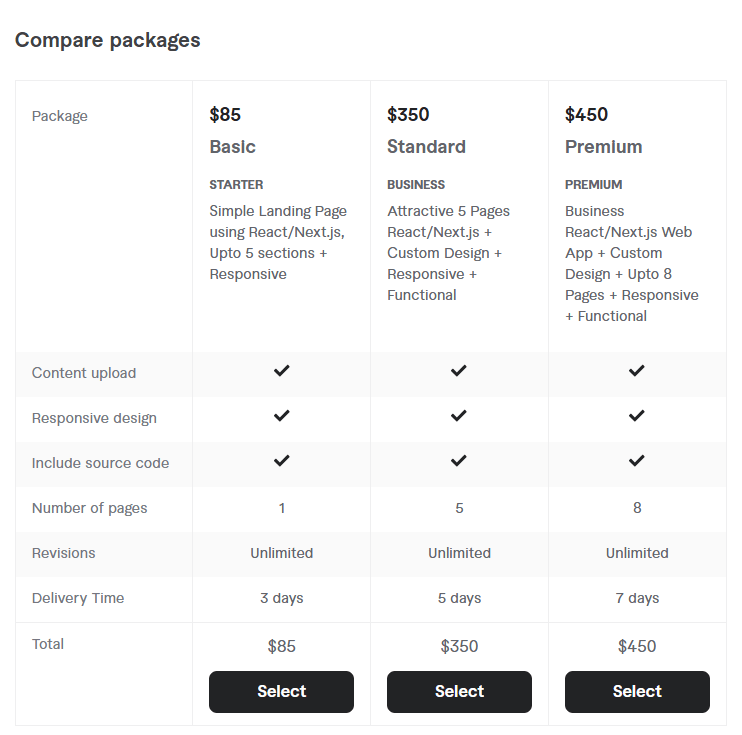
The biggest mistake is thinking a $500 budget must buy an entire web application. It doesn’t. Instead, think about scope.
A developer might create a polished landing page for $200–$400. That same budget won’t cover a complete SaaS application with authentication, payments, databases, dashboards, admin tools, and backend APIs.
Your first question shouldn’t be:
“Who is the cheapest developer?”
It should be:
“What is the most valuable frontend work I can complete within $500?”
That shift in thinking makes the whole hiring process easier.
Where to Find Frontend Developers Under $500
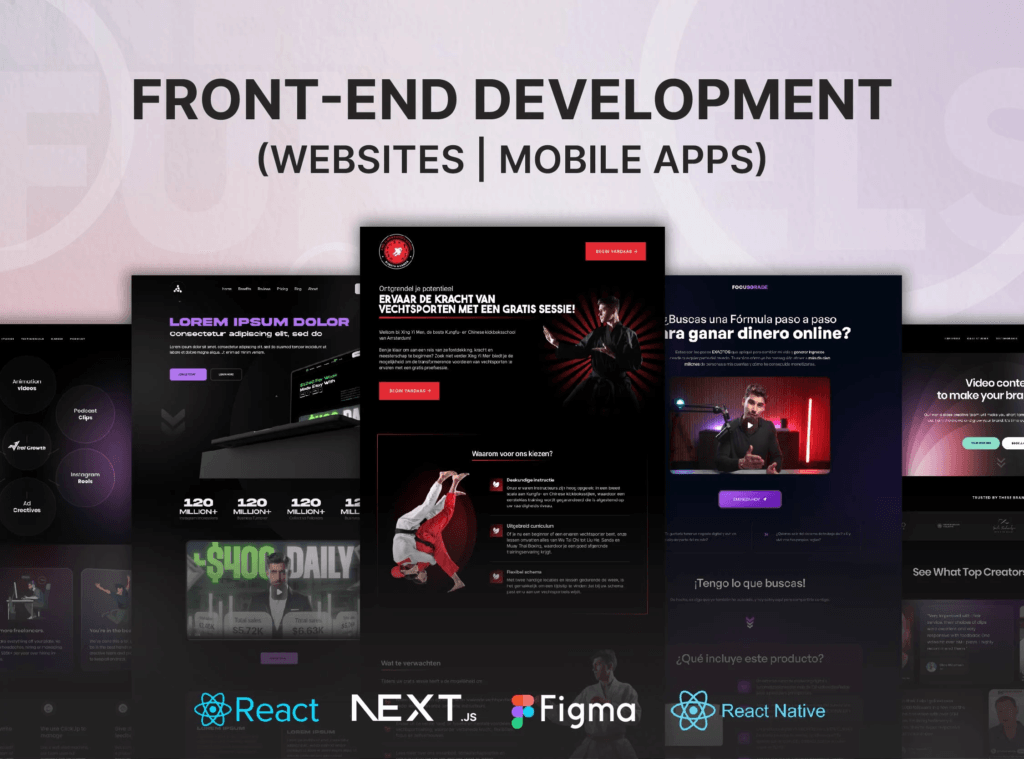
Fiverr lets you compare freelance developers by service, portfolio, reviews, delivery options, and pricing. Instead of browsing every web-development service, start with a focused search:
- Frontend development
- React development
- Next.js development
- HTML CSS JavaScript
- Figma to React
- Responsive website
- Landing page development
- Frontend bug fixing
- Tailwind CSS development
Browse frontend and web development freelancers on Fiverr →
Don’t choose a freelancer simply because the starting price is low — that package may cover only one page or a very small task.
What to Look for in a Frontend Developer
1. Strong HTML, CSS, and JavaScript Skills
These are the foundation of frontend development. A developer should clearly understand how to structure pages with HTML, create layouts with CSS, and add behavior with JavaScript. MDN’s curriculum places semantic HTML, CSS fundamentals, CSS layout, and JavaScript fundamentals among the core skills.
2. Responsive Design Experience
Your site should adapt across desktop, laptop, tablet, and mobile. Responsive design is the practice of making layouts and features adapt to different screen sizes and resolutions — MDN treats this as core to modern web development.
Ask: “Will the website be responsive on mobile, tablet, and desktop?” Don’t assume “website development” automatically means good responsive behavior.
3. Experience With Your Specific Framework
If your project needs React, hire someone who actually works with React — not someone who says “I can work with any technology.” Ask for examples; a portfolio with similar work is stronger evidence than a list of technologies in a profile.
React vs. Plain HTML/CSS/JavaScript
You don’t need React just because it’s popular.
| Project Type | Likely Needs |
|---|---|
| Simple landing page | HTML, CSS, JavaScript, contact form integration |
| Interactive dashboard | React, TypeScript, API integration, state management, authentication integration |
| Large web application | React (or another framework), backend, database, authentication, APIs, testing, deployment |
The bigger the technical scope, the harder it becomes to keep the whole project under $500.
The Hiring Process: Step by Step
Step 1 — Define Your Project Before Searching
Don’t start by scrolling random profiles. Write down what you need. Compare:
❌ “I need a React developer.”
✅ “I need a responsive landing page for a SaaS product. I have a Figma design that needs to be converted into React and Tailwind CSS. The page should work on desktop and mobile, with final code delivered through Git.”
The second version gives a freelancer something concrete to evaluate.
Step 2 — Decide What You Already Have
Ask yourself: Do I have the design? The content? The images? The hosting? The API? The backend? The domain? Developers shouldn’t have to guess what they’re responsible for.
Step 3 — Break the Project Into Deliverables
Instead of “Build my website,” list it out:
- Homepage
- Pricing section
- Features section
- FAQ section
- Contact section
- Responsive mobile layout
- Interactive navigation
- Form validation
- Final source code
This is especially important with a $500 cap.
Step 4 — Set Your Maximum Budget
Example: Target $300–$400, Maximum $500 — leaving room for unexpected requirements. Don’t force a genuinely larger project into $500; reduce scope or increase budget instead.
Step 5 — Review the Portfolio
Look for clean layouts, mobile responsiveness, good typography, consistent spacing, useful animations, interactive components, modern UI, fast-loading pages, and accessible interfaces. Ask to see a live project, not just screenshots — a screenshot can hide problems that a live test (navigation, mobile layout, buttons, forms, loading, animations) reveals.
Step 6 — Look at the Code When Possible
If public GitHub repos or sample code are available, look for organized components, clear naming, reusable code, sensible file structure, useful comments, and consistent formatting — not necessarily the most complex code, but understandable and maintainable code.
Step 7 — Read Recent Reviews
Look for comments on communication, following instructions, technical knowledge, speed, reliability, problem solving, revisions, and final quality. Recent reviews matter more, since a freelancer’s current service may differ from what they offered months or years ago. Prioritize reviews from projects similar to yours.
Step 8 — Ask Technical Questions
- Which technology would you recommend for this project and why?
- Have you built similar frontend projects?
- Will the site be responsive across desktop, tablet, and mobile?
- Will I receive the complete source code?
- How will you test the final website?
- Do you handle frontend bugs after delivery?
- Can you work from my Figma design?
Step 9 — Ask About Performance
Google’s web.dev explains that Core Web Vitals focus on important aspects of user experience, including loading performance, responsiveness, and visual stability — with LCP, INP, and CLS as the current metrics. Ask: “Will you test the frontend performance before delivery?” and “Will you optimize images, fonts, CSS, and JavaScript where appropriate?” Don’t expect a promised “perfect score” — real-world performance depends on hosting, network, devices, and third-party scripts too.
Step 10 — Ask About Accessibility
Accessibility means making a website usable by as many people as possible, including people with disabilities — keyboard navigation, clear labels, good color contrast, semantic HTML, accessible forms, alt text, appropriate headings, and focus states. MDN treats this as core to web development. Ask: “Will you follow basic accessibility best practices in the frontend?”
Step 11 — Confirm Browser Support
Tell the developer which browsers matter: “Please make sure the website works properly in current versions of Chrome, Safari, Edge, and Firefox.” You don’t need to demand support for every old browser — that adds unnecessary work.
Step 12 — Discuss Git and Source Code
Ask whether they work with Git/GitHub. You may want repository access, complete source code, a README, environment setup instructions, build instructions, and deployment notes — this makes future maintenance much easier.
Step 13 — Confirm the Revision Policy
Ask how many revisions are included, and what counts as one. Changing a button color is very different from rebuilding an entire page — define the difference up front.
Step 14 — Use Milestones for Larger Projects
- Setup — project structure and basic components
- Main UI — homepage and primary sections
- Responsive Design — mobile and tablet optimization
- Interactions — forms, menus, animations, and other behavior
- Testing — browser testing and final fixes
What Can You Realistically Build for $500?
| Budget Range | What You Can Target |
|---|---|
| $100–$200 | One landing page, simple HTML/CSS, minor frontend fixes, basic responsive work, small UI components |
| $200–$350 | A polished landing page, several simple pages, Figma-to-code work, a basic React interface, responsive business frontend |
| $350–$500 | More complex React frontend, multiple responsive pages, dashboard UI, advanced interactions, larger Figma conversion, more detailed frontend work |
These aren’t fixed Fiverr pricing rules — they’re a way to think about scope. A developer’s experience, location, specialization, package, deadline, and project complexity all affect actual price.
What Usually Doesn’t Fit Under $500
Be cautious with: full SaaS applications, complex e-commerce systems, large marketplaces, custom social networks, advanced multi-role dashboards, full-stack applications, complex authentication systems, large API integrations, payment systems, and extensive backend development. A very low starting price may cover only a small part of a project like this — always read the package details.
Frontend vs. Full-Stack Developer
A frontend developer focuses primarily on the user-facing side. A full-stack developer can generally work on both frontend and backend.
- Already have a working backend API? → You likely just need a frontend developer.
- Need database, authentication, server, APIs, payment processing, or an admin system? → You need full-stack development.
Don’t pay for full-stack expertise if your project only requires a focused frontend.
Figma-to-Code: A Great $500 Use Case
If a designer has already created your website in Figma, turning that design into a working site is a clearly defined frontend task. Provide the developer with:
Figma file · images · fonts · brand colors · content · responsive requirements
…and request delivery in HTML/CSS, React, Next.js, Tailwind CSS, or your agreed technology. This is often easier to scope than “design and build my entire website.”
A Reusable Frontend Developer Brief Template
PROJECT OVERVIEW
I need a frontend developer to build [describe project].

MAIN GOAL
The primary goal is [explain desired outcome].

TARGET AUDIENCE
The website/app is for [describe users].

TECHNOLOGY
Preferred: [React / Next.js / Vue / HTML-CSS-JS / Tailwind / TypeScript]
I am open to alternatives if you can explain why they're better.

PAGES / SCREENS
- [Page 1]
- [Page 2]
- [Page 3]

FEATURES
- [Feature 1]
- [Feature 2]

DESIGN
I will provide [Figma / design files / reference].
Desired style: [modern / minimal / professional / etc.]

RESPONSIVE REQUIREMENTS
Desktop, tablet, mobile.

BROWSER REQUIREMENTS
Current Chrome, Safari, Firefox, Edge.

PERFORMANCE
Please follow reasonable performance practices and optimize assets.

ACCESSIBILITY
Please use semantic HTML and basic accessibility best practices.

DELIVERABLES
Complete source code, required assets, setup instructions, final
responsive frontend.

BUDGET
Maximum: $500

TIMELINE
Expected delivery: [number] days

REVISIONS
[Number] revision rounds

ADDITIONAL NOTES
[Anything else the developer should know]
A brief like this is far easier to quote than “I need a professional React website.”
Comparing Multiple Developers
Use a simple scoring system when you have a shortlist:
| Factor | Developer A | Developer B | Developer C |
|---|---|---|---|
| Similar portfolio | 5/5 | 4/5 | 3/5 |
| Technical fit | 4/5 | 5/5 | 5/5 |
| Communication | 5/5 | 4/5 | 3/5 |
| Reviews | 5/5 | 5/5 | 4/5 |
| Budget fit | 4/5 | 3/5 | 5/5 |
| Timeline | 5/5 | 4/5 | 4/5 |
| Source code | 5/5 | 5/5 | 4/5 |
This isn’t a scientific ranking — it’s a decision tool that forces you to weigh more than price.
Signs of a Strong Frontend Developer
Look for freelancers who:
- Ask questions before starting
- Understand your target audience
- Explain technical choices clearly
- Have relevant examples
- Build responsive interfaces
- Understand accessibility
- Care about performance
- Communicate clearly
- Define deliverables
- Provide source code
- Test their work
- Can explain their workflow
The ability to explain technical ideas simply is itself a good sign of communication skill.
Red Flags to Watch For
| Red Flag | Why It Matters |
|---|---|
| “I can do everything” | Freelancers claiming expertise in every technology deserve closer examination — ask for specific examples |
| No relevant portfolio | If you need React and they have no React examples, ask why |
| Extremely low price for a huge project | A $50 package can’t magically cover a full $500 scope |
| No questions asked | For a complex project, zero questions may mean they didn’t understand your requirements |
| Unclear deliverables | You should know exactly what you’re buying |
| No source-code discussion | Clarify how and when you receive the code |
| Unrealistic promises | Be cautious of “100% perfect,” “zero bugs,” or impossible deadlines |
| Poor communication before hiring | It’s unlikely to improve during development |
Don’t Hire Based Only on Reviews
A freelancer with 1,000 reviews may specialize in WordPress when you need React. Another freelancer with fewer reviews may have exactly the experience you need. Ask “Are the reviews relevant to my project?” — a much more useful question than “Who has the most reviews?”
Also prioritize recent work. Frontend tools evolve quickly, so a portfolio from several years ago may not reflect current skills. Look specifically for recent React, Next.js, TypeScript, responsive, or dashboard projects.
Test Communication Before a Large Project
For an important project, consider starting small first — one page, one component, one bug fix, or one responsive section. This shows you communication quality, technical ability, speed, attention to detail, and how well they follow instructions before you commit to something bigger.
Testing & Quality Checks
Ask how the freelancer will test the final frontend. A useful answer covers: desktop testing, mobile testing, different browsers, form testing, broken links, layout problems, console errors, and performance checks. For performance, web.dev recommends measuring real user experience with tools like Chrome DevTools, Lighthouse, PageSpeed Insights, and field data.
You don’t need a perfect PageSpeed score — a good technical score doesn’t guarantee good content, navigation, design, or conversion flow, and vice versa. Treat performance metrics as one part of quality control.
Why Mobile Testing Matters
Check menu behavior, text size, button size, images, forms, tables, cards, spacing, and horizontal scrolling — on an actual phone, not just your desktop monitor.
Final Review Checklist
Visual
- Matches the design?
- Fonts, colors, images correct?
- Spacing consistent?
Functional
- Buttons, links, forms work?
- Navigation and interactive elements work?
Responsive
- Desktop / tablet / mobile all checked?
Technical
- No obvious console errors
- Source code delivered
- Setup instructions included
- Required integrations work
Performance
- Images optimized
- Pages load reasonably
- No unnecessary heavy effects
- Layout doesn’t jump unexpectedly
Getting More Value From a $500 Budget
Prioritize based on your goal. For lead generation, focus on:
- Strong homepage
- Clear CTA
- Mobile responsiveness
- Fast loading
- Good form experience
- Trust elements
- Clean navigation
Skip complex animations, 3D effects, advanced dashboards, or dozens of custom components unless they’re essential — a focused project often delivers more value than a bloated one.
Three Ways to Spend $500
| Option | Approach | Best For |
|---|---|---|
| A. One strong landing page | Put the whole budget into one polished page | SaaS, services, startups, lead gen, product launches |
| B. Several simple pages | Home, About, Services, Contact | Small businesses, consultants, freelancers, agencies |
| C. Prototype a larger app | Build the core frontend instead of the full application | Startups, MVPs, product validation, investor demos |
When You Should Increase the Budget
Consider a bigger budget (rather than a harder search) if you need: a complex React application, a large dashboard, multiple user roles, advanced animations, many API integrations, authentication, payment functionality, backend development, database work, extensive testing, or long-term maintenance.
Or reduce scope instead — build the five most important screens first instead of twenty, and validate the idea before spending more.
What If a Freelancer Wants More Than $500?
Don’t automatically reject them — ask if they can reduce scope:
“My maximum budget is $500. Could we build the homepage and core dashboard first, then add the remaining screens later?”
Or: “Which features would you remove to keep the project within $500?” A good freelancer will help you prioritize.
What If Someone Offers to Do Everything for $100?
Be careful. A low price isn’t automatically bad, but if your project needs 10 pages, React, API integration, authentication, animations, responsive design, testing, and deployment — and someone quotes $100 for all of it — ask exactly what’s included. Always compare scope, not just the headline price.
A 12-Step Hiring Process Under $500
- Define the project — write the goal and deliverables
- Choose the technology — use your existing stack or ask for a recommendation
- Set the budget — maximum $500
- Search Fiverr for relevant skills
- Shortlist 3–5 developers — don’t contact dozens
- Check portfolios — focus on similar projects
- Read recent reviews — communication and quality
- Send your brief — the same requirements to every shortlisted developer
- Compare responses — understanding, price, timeline, technical approach
- Ask follow-up questions to clarify anything unclear
- Start with a defined scope — don’t keep adding features
- Test the final product — functionality, responsiveness, accessibility, performance
FAQ
Can I hire a good frontend developer on Fiverr for under $500?
Yes. A $500 budget suits focused projects — landing pages, responsive websites, Figma-to-code work, small React interfaces, and bug fixes. The key factor is scope; a complex full-stack application needs a much larger budget.
What skills should a frontend developer have?
At minimum, strong HTML, CSS, and JavaScript. Depending on your project, you may also need React, Next.js, Vue, TypeScript, Tailwind CSS, API integration, responsive design, accessibility, and performance optimization. MDN’s curriculum identifies these as core frontend skills.
Is React necessary for every frontend project?
No. A simple site may work perfectly with plain HTML, CSS, and JavaScript. React or another framework becomes more useful with complex interaction, reusable components, or application-style behavior.
What can I build with $500?
A polished landing page, small responsive website, Figma-to-code project, small React interface, dashboard prototype, or a focused frontend feature — the exact scope depends on the freelancer and complexity.
Should I hire a frontend developer or full-stack developer?
A frontend specialist if you mainly need the user-facing interface. A full-stack developer if you also need backend functionality, databases, authentication, APIs, or server-side logic.
How do I know if a Fiverr frontend developer is good?
Review their relevant portfolio, recent reviews, technical experience, communication, and ability to explain their approach. A strong portfolio with similar projects is often more useful than a large volume of unrelated reviews.
Should I ask for source code?
Yes, if you’ll need to maintain or update the project later. Clarify whether complete source code and setup instructions are included before starting.
How important is mobile responsiveness?
Very. A modern frontend should adapt to different screen sizes — MDN treats this as core to web development. Always ask the developer to test on mobile as well as desktop.
Related Reading
- The best frontend developers on Fiverr → — compares several frontend specialists, pricing, and technical focus
- Freelance website developers on Fiverr → — for projects that need more than frontend work
- Freelance website development costs → — how project type and stack affect pricing
Final Thoughts
The best way to hire frontend developers on Fiverr under $500 is not to search for the lowest price. Instead, define a focused project and find a freelancer whose skills match it.
Start with the fundamentals: HTML, CSS, JavaScript, responsive design, and the right framework for your project. Then look at relevant portfolio examples, recent reviews, communication, source-code delivery, testing, and revision terms.
For a $500 budget, scope matters more than almost anything else. A polished landing page may fit comfortably; a complete SaaS platform probably won’t. If your project is too large, trim the first version down to the most important features rather than expecting one freelancer to build everything for a small fee.
Performance and accessibility should also be part of your requirements — web.dev treats loading performance, responsiveness, and visual stability as core to user experience, while MDN includes accessibility and responsive design among core frontend practices.
When you’re ready to compare options, find the right frontend developer on Fiverr → and send your project brief before choosing a seller.
The right freelancer isn’t the one who says “yes” to everything — it’s the person who understands your goal, asks useful questions, has relevant experience, gives you a realistic plan, and can deliver the specific frontend work your $500 budget actually covers.
This post contains affiliate links. If you sign up or make a purchase through them, I may earn a commission at no extra cost to you.

Muhammad Hasan is an experienced SEO expert and blog writer passionate about helping businesses connect with top freelance talent. With 4 years of hands-on experience in content strategy and search engine optimization, he specializes in writing SEO-friendly blog posts that rank, engage, and convert.